Eyes Off, Ears Open: Hearing Mabuta With the Lights Down Low

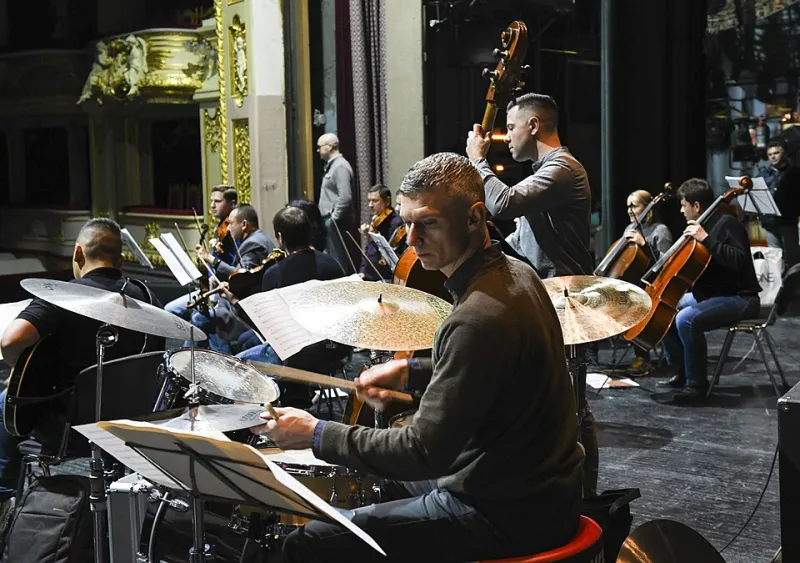
Photo: Manfred Werner - Tsui, CC BY-SA 3.0, via Wikimedia Commons
Mabuta means eyelid. That is not a trivia note or a logo concept; it is a way into the music. On this year's US club run, the most useful thing audiences did was close their eyes for a song. Not the whole set, not as a pose, and not because the lighting was bad. Because the eyelid is a threshold, and Mabuta's music lives near thresholds.
The Name Is an Instruction
Most band names are signposts. Mabuta's is closer to a method. The eyelid is the body's simplest filter: it decides how much light gets in, how much rest the eye gets, how much of the room you take at once. In a live setting, that filter matters. The default concert posture is visual — watch the hands, track the pedals, clock the cue, see who nods at whom. That is useful. It is also a kind of management. You start organizing the performance into visible causes: this player did that, this pedal changed the color, this glance set off the ending. All true, and all only part of the story.
When the eyes close, the organizing changes. You stop tracking and start receiving. The music becomes less a sequence of actions and more a set of pressures: weight, air, distance, hush. For a band like Mabuta, which works with patient grooves and arrangements that leave space, that shift is not a gimmick. It is closer to the intended job.
What Happens When You Stop Watching
At a Chicago club this year, during a mid-set tune built on brushed drums and a bass line that seemed to walk in place, someone near the front closed their eyes and stopped nodding to the beat. From the side, it might have looked like disengagement. It was the opposite. The room seemed to lean in around that person. The sound widened, or maybe the attention did. Either way, the performance changed. The drummer played softer. The horn left a longer gap before entering. The audience did the work of holding the space.
That is the eyelid test in practice. You are not checking whether the band is good. You are checking what else is in the room. With eyes open, you hear the players and the crowd. With eyes closed, you hear the room's own voice: the HVAC hum, the bar door, the glass set down on a table, the couple whispering two rows back, the reflection off a brick wall. In a club, those sounds are not interruptions. They are part of the mix.
Room Sound Is Part of the Set
Mabuta's 2026 US dates tended to favor rooms with personality — plaster, brick, wood, low ceilings, stages close enough that the audience could hear the drummer's sticks click before the hit. In a Brooklyn room, the decay on a muted trumpet note hung around after the beat, not as echo but as atmosphere. In Los Angeles, carpet and a packed floor ate the high end, pushing the drums forward and making the bass feel like it was coming up through the room rather than out of the speakers.
Eyes closed, those differences become compositional. You hear the room respond. The quietest passages — bass alone, a cymbal wash, a single repeated piano figure — are where room sound becomes visual. Not pictures, exactly. More like spaces: a hallway, a held breath, a door left open in another part of the building. The band does not need a screen. The room is the screen.
The Quiet Passages Are the Cinema
Mabuta's loud moments get the applause. The quiet ones get the leaning. This year, the hush before a final theme often felt like the actual climax of the set. Eyes closed, you can hear the audience arrive at the same place: coughs suppressed, glasses set down, chairs stop scraping. That collective attention is an instrument. It changes how players phrase. A drummer does not have to hit harder; a horn does not have to push. The room carries.
In festival fields, wind and chatter erase those details. In clubs, they are the point. The quiet passages are not filler between the impressive parts. They are where Mabuta's global-jazz language becomes most legible, because you can hear how the rhythm section breathes, how the melody instruments leave room for each other, how a simple repeated figure can do the work of a whole section.
A Practical Test for the Next Show
Try it for one song, not the whole set. Pick a mid-tempo tune, not a ballad. Close your eyes after the first chorus. Notice the bass-drum conversation. Notice how the guitar leaves space instead of filling it. Notice when the horn enters from silence. Then open your eyes. You will likely see the band working less obviously than you imagined. That is not anti-visual. It is rebalancing.
The visual show is still there — hands, breath, posture, the small signals between players. But it is no longer the only channel. The eyelid test makes the music bigger by making the room smaller. That is the reward.
Why It Matters
Mabuta's music is often described as global jazz, but global here means multiple centers of gravity, not a passport check. The eyelid test is one way to hear them without sorting by geography. You stop listening for African or European or American markers and hear rhythm, melody, room. The name is not a gimmick. It is an invitation to lower the lights on your own terms, even in a bright room with a drink in your hand. The next time Mabuta plays a US club, try one tune with your eyes closed. The quietest passage might be the most visual thing in the room.